The following kindergarten number games are easy to play, generally, use available classroom materials and are short and simple.
Games provide opportunities for problem solving and interaction between kids. Children at different developmental levels play together and learn from each other.
It’s often easy to observe specific children as they play and discover areas where they would benefit from more teaching or learning experiences. Due to the hands-on nature of games, they help focus the children on the math concepts you want them to practice.
Train Game
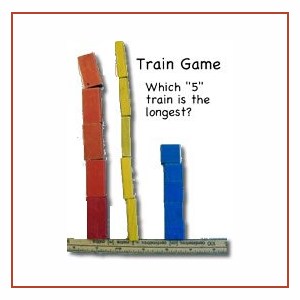
Materials:
- Wooden blocks - that have a variety of sizes (see image)
- A ruler or something to make a starting line for each child.
Procedure:
- Demonstrate first.
- On the floor or carpet, each child places the ruler (not used for measuring) as a starting line
- If the number is 5, the children will make rows of 5 blocks, each time with a different color block until the teacher says “Stop”.
Then they say which one of their trains is longest or shortest. - Wooden colored blocks are a great math resource to use when playing kindergarten number games. They are durable and can be used for a variety of teaching purposes.
Five of Each
This is a great short and simple game for developing number sense in kids. Change the number, depending on which one you want them to work with.
Materials:
- A mat for each child
- Pattern blocks piled in the center of the carpet or table
- Number cards 1 - 10
Procedure:
- Choose a number and show the children, in this case, say “5”
- Children make designs with pattern blocks using only five yellow blocks, then five blue blocks, then five green blocks
- They then show their partner or the child next to them what they made
- The teacher picks a different number.
Ready, Set, Go
This kindergarten number game is a timed game that adds excitement to counting sets of numbers.
Materials:
- A mat for each child
- Unifix® math cubes
- Large wall clock
Procedure:
- A group of about 10 children sits on the carpet with a pile of Unifix® math cubes in front of them.
- Half of the students watch the second-hand on the clock (assuming you have a large wall clock)
- When the second-hand points to the 12 (I put a bright red sticker above the number 12 on the clock to make this easy), they say “Ready, set, go - make 5!” (or whatever number you are working on)
- The other 5 students have to build as many sets of five as they can before the second-hand goes around the clock to the top again.
- When it is at the top, the children yell “Stop!” and every one counts how many sets of 5 are on the carpet
- Have the builders break their blocks apart for a minute, push them back to the center and quickly change places with the timer kids
- Don’t focus on how many sets each student made or who made the most sets.
- Help those who are making sets incorrectly. The important thing is that the children are practicing making sets of a certain number and developing their number sense.
Bear Hike
I base this game on whatever story I’ve read to the kids that day. Call it whatever goes with your story!
Materials:
- 5 bears, or cats, or dog counters
- 2 small different colored cards or mats for each child
Procedure:
Tap into the kids’ love of pretending and they grasp the concepts of adding and subtracting at the same time. Just tell a story and have the kids follow with their toys.
For example, “The bears went for a walk. They came to a beach and a lovely green lawn (show them the blue and the green mats). 4 went into the water (kids put four counters on the blue mat) and the rest went on the grass. How many are on the grass?” Let the students just say the answers out loud.
Then, “Three of the bears were cold in the water and so they walked to the grass. How many are left in the water? How many bears all together in the water and the grass?”
Keep the bear stories going until children lose interest. Let the children make up their own number stories.
Recording their games
After a few play times, guide the children into recording their thinking with pictures and a few words. For example, children color one side of a paper blue and the other green and then draw bears on each side. They may print the number of bears on each side or how many all together.