


Learning Centers
Why have learning centers in your classroom?
What you believe children learn from taking part in learning centers is important.
Many parents (and educators) think of center time in a primary classroom as a way to keep children busy in between "real" school activities.
Children learn through play and play is a child's work. Having children participate in centers creates opportunities for students to acquire skills and knowledge.
Unfortunately in some learning environments, play is viewed as unnecessary and learning by touch and discovery, problem solving, and structured and unstructured hands
 on exploration is not valued.
When setting up learning centers in your kindergarten classroom, keep in mind that each center has specific learning outcomes for the students.
Sample skills and knowledge acquired in the Water Learning Center...
Physical
- Gross movement - lifting, grading, filling, emptying, pouring
- Fine movement skills - eye-hand coordination (pouring from one container to another)
- Leveling of water
- Eye-hand tracking (water level in tubing)
- Perception - directional, texture - ice to solid to liquid, visual- higher longer wider, nearer, far, lateral right and left
Social / Emotional

- Working in cooperation in a group, sharing, discovery
Cognitive
- Language - writing about water experiences, vocabulary - low levels, higher levels, oral expression, imaginary play
- Number - quantity more/less, equivalent, weight, comparison, volume full/empty, sequencing different sizes of bottles, surface areas, relationships (in, on, under, beside) time, different rates of how long to flow or empty
- Science - observing generalizing, comparing, classification, measuring, explaining, temperature, absorption, floating, sinking, observing air in water, liquid qualities, water finds its own levels, wave action
Adult participation in centers can be beneficial...
Having adults who are familiar with the learning outcomes of the centers join the learning groups, encourages kids to try to solve problems, experiment and record their learning. As the adults rotate around the centers modeling behaviors and introducing new activities, the children not only copy them but take the ideas to new levels.
Example:

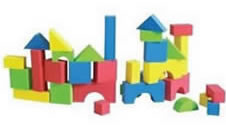
One day I joined the children in the math manipulative center and began to stack plastic rectangular blocks which the children had ignored for most of the term. After making the tower, I measured it by comparing it next to a chair, recorded my observation with an illustration on a chart – “Mrs. B’s tower is shorter than the chair", all the time verbalizing my thinking processes.
I did this a few times over a couple of weeks and introduced language such as tall, taller than, shorter than, measure, compared to, rectangular prism. Tower building and measuring soon became a favorite activity.

Focus on experimentation and discovery
There are fewer disruptions between children when the focus is on experimentation and discovery.
For example, “Is it easier to balance the thin rectangular blocks or the fat rectangular blocks? Do more items in the water center float or or do more items sink? Is it easier to make square structures or triangular structures with the magnet rods and balls?”
Help your students' parents to understand the value of learning centers
Once you feel confident and knowledgeable about what the students are learning at center times, it is helpful to inform parents in monthly newsletter articles. Each newsletter can focus on a different center.

Working at a learning center
I refer to the children as "working at a learning center" rather than "playing in centers".
Teach the children:
- how to join in to a new center by modeling fairness, sharing, and making choices
- inclusion of all, how to welcome a new child to a group, how to join into a group, "What game are you playing? How can I join in?"
Avoid conflicts by limiting materials...
- Avoid putting certain items in the centers if they do not contribute to a peaceful classroom atmosphere.
- Some toys hinder imaginative play. Imaginative play with licensed television or movie toys is limited by the shows or movies and is often focused on fighting.

- I do use rubber toy animals but have plenty of teacher or parent role-playing time with them. The children tend use the animals to fight or bash at each other and need to learn how to build worlds for the toys, to create and solve problems for them, and to increase sharing and fairness vocabulary. At times certain items become too popular and cause too many disruptions. I found the easiest remedy was to make the items disappear for a while and try again another time.
NEXT PAGE: Find out how to keep your learning centers running efficiently and smoothly... -

