Throughout the year, when teaching kindergarten and preschool math, provide opportunities for students to solve problems that use the skills of classification, matching, building number sets, making patterns, comparing objects, making graphs and recording information.
Offer lots of hands-on experiences using math manipulatives and show the children different ways of recording their math investigations.
Listed below are some of the math areas that students are working towards learning.
The items listed on this page are my favorite math teaching materials for math activities.
They can be used for teaching math concepts, for playing math games and for imaginative play.
Kindergarten and preschool math topics
Although government requirements for specific math skills children should learn, differ geographically, generally, young children should have lots of math experiences in the following areas:
- Building Number Sense – an intuitive sense of number developed by participating in hands-on math experiences
- Counting
- Sorting/classifying and sequencing objects – help children associate things that belong together, that are different
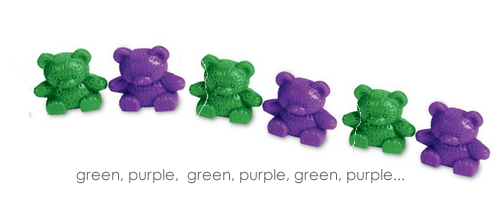
- Patterns – provide experiences for children to create patterns
- Measurement – calendar activities and comparing time, temperature, area, length
- Geometry – 3D objects and 2-D shapes & spatial sense, including symmetry
- Graphs and tallies – statistics and probability – representing information with pictures and things
- Money – coin vocabulary and simple counting
- Fractions
- Problem Solving
- What are doubles?
Number Operations
Introduce students to the number operations of adding, subtracting, multiplying and dividing with concrete objects or real things. If a child has a number sense or an intuitive understanding of numbers to 5, limit any number operation experiences to the number 5 or less. Keep activities hands on and have your students record their learning with words and pictures.
Children who have plenty of hands-on math experiences will feel more confident about themselves as young mathematicians and appreciate that there is value in learning math.